The Monasteries of Sakya and Ngor: Places of the Tradition in Tibet and in Exile
Sakya Monastery in south-central Tibet stands for a tradition that has also spread beyond Tibet. Ngor Monastery belongs to it and arose as the center of a lineage of its own within the Sakya school. The histories of the two monasteries, the building of exile communities and the rebuilding in Tibet are closely linked, yet each needs to be looked at separately.
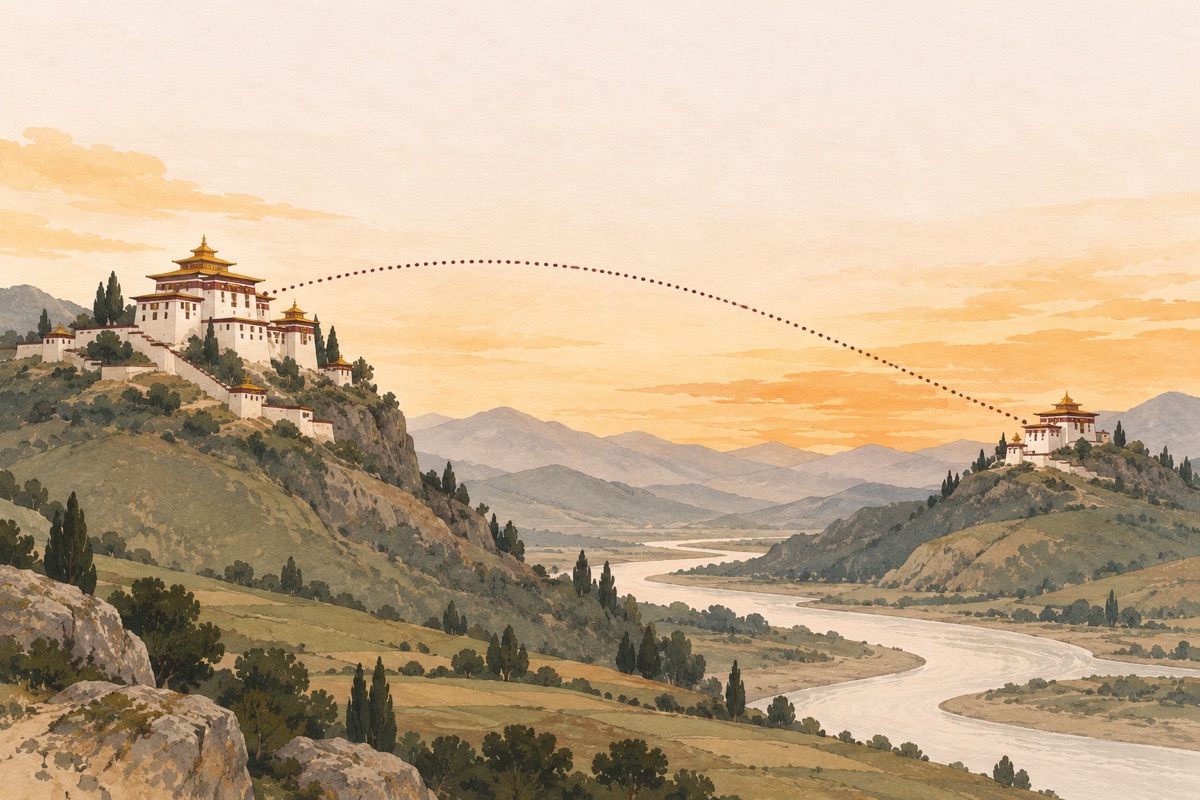
What Is Sakya Monastery?
Sakya Monastery was founded in 1073 in south-central Tibet. It is tied to a teaching and ritual tradition that Sakya communities still carry on today. That tradition is limited neither to a single building nor to one region.
Over time other centers arose, Ngor among them. A distinction has to be made between how a center is administered and its teaching and ritual tradition: sharing a tradition does not mean sharing an administration.
Ngor Monastery: A Lineage of Its Own Within Sakya
In 1429 Ngorchen Kunga Zangpo founded Ngor Evam Choden Monastery as the center of a separate lineage within the Sakya tradition. A span of 356 years separates the founding of Sakya and Ngor.
Ngor is independent of Sakya Monastery in its administration but follows the same teaching and ritual tradition. Its own lineage therefore does not form a separate school.
The name Evam comes from the syllables E and WAM, which according to tradition are linked with a dream of the founder.
Sakya in Exile
After 1959 many Sakya clergy left Tibet and rebuilt their communities in India and Nepal. The phrase "Sakya in exile" refers to these communities outside Tibet, whose beginnings are connected with the events after 1959.
This development has to be kept apart from the history of the monasteries in Tibet. It concerns people and communities in new places, not the monasteries founded in medieval Tibet.
Rebuilding the Monasteries in Tibet
In the 20th century, monasteries in Tibet suffered damage. Some were rebuilt later, but not every site was restored. Because the available information does not allow individual buildings to be dated, this development can only be described in outline.
The rebuilding in Tibet concerns destroyed monasteries, while the building up in India and Nepal concerns communities that had left Tibet. Both are part of the tradition's history in the 20th century, but they are different processes.
Sakya Today
Sakya communities exist today in Asia, Europe and North America. The tradition is thus present on three continents and reaches far beyond the region where Sakya Monastery began.
Today's communities do not form a single institution. What unites them is a shared teaching and ritual tradition, not a common administration. The relationship between Sakya Monastery, founded in 1073, and Ngor Monastery, founded in 1429, shows this too: both share one tradition but are managed independently of each other.